Showing posts with label Kachina Martin. Show all posts

Tuesday, October 9, 2012

Featured Artist: Kachina Martin

During the six weeks of 'Black White Red' we'll focus on individual artists here on our blog. Every week, several artists will be featured. Today, we're pleased to introduce to you:  Kachina Martin


Crimson Shadows
Nuno felting using
hand-dyed silk &
hand-dyed cotton
68" x 6" 
Crimson Shadows, detail
Nuno felting using
hand-dyed silk &
hand-dyed cotton
68" x 6" 
Crimson Shadows combines nuno felting with hand-dyed silk and cotton pieces.  Nuno felting enables me to combine my own fabrics with wool to add depth and dimension to my wearable pieces, creating a sculptural quality to my work.  I feel that my pieces' wearablity enhances, rather than detracts from, their depth. That the work will be worn is significant, indeed essential, to its artistic value.  It is when the work is worn-when the wearer imbues it with her own sense of style and integrates it into her daily life- that the work truly comes to life.


E is for (front)
Vintage dress, mended;
altered with embroidered
text and images,
supported on
recycled dress
form with
paper mâché accents
from recycled texts
14" x 8" x 6"


E is for (back)
Vintage dress, mended;
altered with embroidered
text and images,
supported on
recycled dress
form with
paper mâché accents
from recycled texts
14" x 8" x 6"
 Little Girls: The Alphabet Series - E

Easy - [ē-zē], adjective. 1. requiring or indicating little effort, thought, or reflection. 2. readily taken advantage of. 3. readily available. 4. (slang) sexually promiscuous.  I have been working with narrative and context in my most recent work, The Alphabet series, exploring how garments can be altered to reflect as well as defy societal norms and expectations, particularly of women. All the words selected for the series are common, and yet, are words that are layered with meaning, and can be used as a pejorative term.  Thus, the finished piece speaks to the notion of "women's work" - the needle arts - as well as how society view the role of women. I aim to defy the viewer's expectation of what fiver is, can, or should be and re-imagine these vintage dresses as enduring, sculptural artifacts.
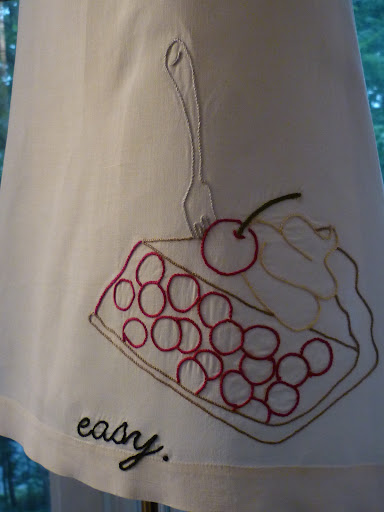

E is for (back,detail)
Vintage dress, mended;
altered with embroidered
text and images,
supported on
recycled dress
form with
paper mâché accents
from recycled texts
14" x 8" x 6"
Artist’s Statement

      My most cherished childhood memories center on fabric - the comfort of a blanket edged in silk, the feel of a well-worn cotton tee, the nubby texture of a hand-knit sweater.  As the daughter of a mother who teaches in the field of fashion and design, I was acutely aware at a young age of the transformational properties of clothing.  My artistic interests were equally shaped by my grandmother.  Guided by her firm hands, unwieldy lengths of fabric were coaxed to behave, ultimately shaped into a variety of forms marked by perfect, crisp seams.  The drama that surrounded the cutting of the fabric felt epic – she possessed such confidence as she sliced thorough layers of cloth, following the edges of the whisper-thin tissue paper that outlined its eventual shape.  My grandmother taught me to decode the language of patterns, to sew, and later, to knit, crochet, and embroider. 

      When I discovered shibori, I was awed by the limitless possibilities inherent in this ancient Japanese dyeing process.  Areas of pure color are seamlessly blended in an endless variety of tints and shades, revealing where color meets resist, creating a rich visual texture that transcends the notion of pattern.  My experimentation with dyes introduced me to felting, and I am fascinated by the sculptural properties of wool.  Nuno felting enables me to combine my own fabrics with wool to add depth and dimension to my wearable pieces.  I feel that my pieces’ wearability enhances, rather than detracts from, their depth.  That the work will be worn is significant, indeed essential, to its artistic value.  It is when the work is worn—when the wearer imbues it with her own sense of style and integrates it into her daily life—that the work truly comes to life. 

      While all of my work fiber-based, not all of my pieces are intended to be worn.  I am drawn to old garments that show evidence of the hand that created the piece as well as the person who wore it.  These indelible marks—stitches, stains, mended holes, and spots rubbed almost bare by continual contact with the body—speak to the hours invested in the making of the garment as well as the years that have passed as it was worn, again and again.  I am interested in ways in which to transcend both the utilitarian nature and the inevitable entropy that continually affect these garments and reimagine them as enduring, sculptural artifacts.  In so doing, I aim to defy the viewer’s expectation of what fiber is, can, or should be.  In my most recent work, I have been working with both narrative and context, exploring how garments can be altered to reflect as well as defy societal norms and expectations, particularly of women. 


http://www.howlingruth.com/

Friday, May 18, 2012

Featured Artist: Kachina Martin

From April 14th, to June 2nd, we present "Refuse/Re-seen" during which we'll focus on individual artists here on our blog.  Today, we're pleased to introduce to you:  Kachina Martin

      My most cherished childhood memories center on fabric - the comfort of a blanket edged in silk, the feel of a well-worn cotton tee, the nubby texture of a hand-knit sweater.  As the daughter of a mother who teaches in the field of fashion and design, I was acutely aware at a young age of the transformational properties of clothing.  My artistic interests were equally shaped by my grandmother.  Guided by her firm hands, unwieldy lengths of fabric were coaxed to behave, ultimately shaped into a variety of forms marked by perfect, crisp seams.  The drama that surrounded the cutting of the fabric felt epic – she possessed such confidence as she sliced thorough layers of cloth, following the edges of the whisper-thin tissue paper that outlined its eventual shape.  My grandmother taught me to decode the language of patterns, to sew, and later, to knit, crochet, and embroider.  


Orthogenesis
34x21x1"       2012
     When I discovered shibori, I was awed by the limitless possibilities inherent in this ancient Japanese dyeing process.  Areas of pure color are seamlessly blended in an endless variety of tints and shades, revealing where color meets resist, creating a rich visual texture that transcends the notion of pattern.  My experimentation with dyes introduced me to felting, and I am fascinated by the sculptural properties of wool.  Nuno felting enables me to combine my own fabrics with wool to add depth and dimension to my wearable pieces.  I feel that my pieces’ wearability enhances, rather than detracts from, their depth.  That the work will be worn is significant, indeed essential, to its artistic value.  It is when the work is worn—when the wearer imbues it with her own sense of style and integrates it into her daily life—that the work truly comes to life.

Orthogenesis (detail)
34x21x1"       2012

      While all of my work fiber-based, not all of my pieces are intended to be worn.  I am drawn to old garments that show evidence of the hand that created the piece as well as the person who wore it.  These indelible marks—stitches, stains, mended holes, and spots rubbed almost bare by continual contact with the body—speak to the hours invested in the making of the garment as well as the years that have passed as it was worn, again and again.  I am interested in ways in which to transcend both the utilitarian nature and the inevitable entropy that continually affect these garments and reimagine them as enduring, sculptural artifacts.  In so doing, I aim to defy the viewer’s expectation of what fiber is, can, or should be.  In my most recent work, I have been working with both narrative and context, exploring how garments can be altered to reflect as well as defy societal norms and expectations, particularly of women.

Monday, October 17, 2011

Featured Artist: Kachina Martin

From September 10, to November 5th, we present "Felt So Good" during which we'll focus on individual artists here on our blog.  Today, we're pleased to introduce to you: Kachina Martin

Aubergine Moss
nuno felting 98"x8"

 Artist’s Statement

My most cherished childhood memories center on fabric - the comfort of a blanket edged in silk, the feel of a well-worn cotton tee, the nubby texture of a hand-knit sweater.  As the daughter of a mother who teaches in the field of fashion and design, I was acutely aware at a young age of the transformational properties of clothing.  My artistic interests were equally shaped by my grandmother.  Guided by her firm hands, unwieldy lengths of fabric were coaxed to behave, ultimately shaped into a variety of forms marked by perfect, crisp seams.  The drama that surrounded the cutting of the fabric felt epic – she possessed such confidence as she sliced thorough layers of cloth, following the edges of the whisper-thin tissue paper that outlined its eventual shape.  My grandmother taught me to decode the language of patterns, to sew, and later, to knit, crochet, and embroider.

Aubergine Moss, detail

When I discovered shibori, I was awed by the limitless possibilities inherent in this ancient Japanese dyeing process.  Areas of pure color are seamlessly blended in an endless variety of tints and shades, revealing where color meets resist, creating a rich visual texture that transcends the notion of pattern.  My experimentation with dyes introduced me to felting, and I am fascinated by the sculptural properties of wool.  Nuno felting enables me to combine my own fabrics with wool to add depth and dimension to my wearable pieces.  I feel that my pieces’ wearability enhances, rather than detracts from, their depth.  That the work will be worn is significant, indeed essential, to its artistic value.  It is when the work is worn—when the wearer imbues it with her own sense of style and integrates it into her daily life—that the work truly comes to life. 

Bits and Pieces
nuno felting, wool roving, silk yarns, silk fabric 78"x11"

While all of my work fiber-based, not all of my pieces are intended to be worn.  I am drawn to old garments that show evidence of the hand that created the piece as well as the person who wore it.  These indelible marks—stitches, stains, mended holes, and spots rubbed almost bare by continual contact with the body—speak to the hours invested in the making of the garment as well as the years that have passed as it was worn, again and again.  I am interested in ways in which to transcend both the utilitarian nature and the inevitable entropy that continually affect these garments and reimagine them as enduring, sculptural artifacts.  In so doing, I aim to defy the viewer’s expectation of what fiber is, can, or should be. 

Bits and Pieces, detail

Bio

Kachina Martin is a fiber artist who teaches art and art history at Muhlenberg High School in Laureldale, PA.  She earned a B.A. in English and French with an Art History minor at Albright College; she received her Master’s in Art History from Temple University.  Kachina has also studied fiber arts at the Arrowmont School of Arts & Crafts, the University of the Arts, Touchstone Center for Crafts, and Cannon Hill Studios.

In addition to her work as a public educator, Kachina has also lectured at St. Francis University, Albright College, La Salle University, Philadelphia College of Textiles and Science, and Temple University.
 
For further information, please visit www.howlingruth.com. 

Flume
nuno felting 78"x10"

Flume, detail


Kachina Martin is one of three artists exhibiting in our gallery whose work has been featured in the book, 500 Felt Objects.


Saturday, June 11, 2011

Featured Artist: Kachina Martin

 During the seven weeks of '"Size Matters" we'll focus on individual artists here on our blog. Every week, several artists will be featured. Today, we're pleased to introduce to you: Kachina Martin

Crocus
Kachina Martin is a fiber artist who teaches art and art history at Muhlenberg High School in Laureldale, PA.  She earned a B.A. in English and French with an Art History minor at Albright College; she received her Master’s in Art History from Temple University.  Kachina has also studied fiber arts at the Arrowmont School of Arts & Crafts, the University of the Arts, Touchstone Center for Crafts, and Cannon Hill Studios.

Crocus, detail
In addition to her work as a public educator, Kachina has also lectured at St. Francis University, Albright College, La Salle University, Philadelphia College of Textiles and Science, and Temple University.

For further information, please visit http://www.howlingruth.com/

Monday, October 11, 2010

Featured Artist: Kachina Martin

During the eight weeks of 'simply irRESISTible' we'll focus on individual artists here on our blog. Every week, three artists will be featured. Today, we're pleased to introduce to you: Kachina Martin from Adamstown, PA.


About the piece: "The stretched yardage is the result of various experiments with dyeing and discharging, allowing colors to blend and fade, creating a visual texture that transcends pattern. All three pieces were subjected to the same process and dyes, yet each was bound differently; the minor variations in binding, dyeing times, and discharging created three distinct but visually coherent pieces. I have chosen to display the three pieces as part of a larger whole to illustrate the responsiveness of the process to even the most subtle changes.

Much of my work is wearable, and the pieces on display in the boutique also utilize shibori, as well as pieces of vintage fabric. I feel strongly that the wearability of my work enhances its depth and beauty. That the work will be worn is significant, indeed essential, to its artistic value. It is when the work is worn—when the wearer imbues it with her own sense of style and integrates it into her daily life—that the work truly comes to life."

Artist Statement/Biography:

Kachina Martin is an educator and fiber artist based in Adamstown, PA - which, as a nearby billboard famously attests, is "known for antiques and hats." She is a member of the Pennsylvania Guild of Craftsmen, which recently awarded her state juried status. Her work is carried in several boutiques and has been featured in a number of juried shows.

She earned a B.A. in English and French with an Art History minor at Albright College; she received her Master's in Art History from Temple University. Kachina has also studied fiber arts at the Arrowmont School of Arts & Crafts, the University of the Arts, Touchstone Center for Crafts, and Cannon Hill Studios.

In addition to her work as a public educator, Kachina has also lectured at St. Francis University, Albright College, La Salle University, Philadelphia College of Textiles and Science, and Temple University.

For further information, please visit www.howlingruth.com.